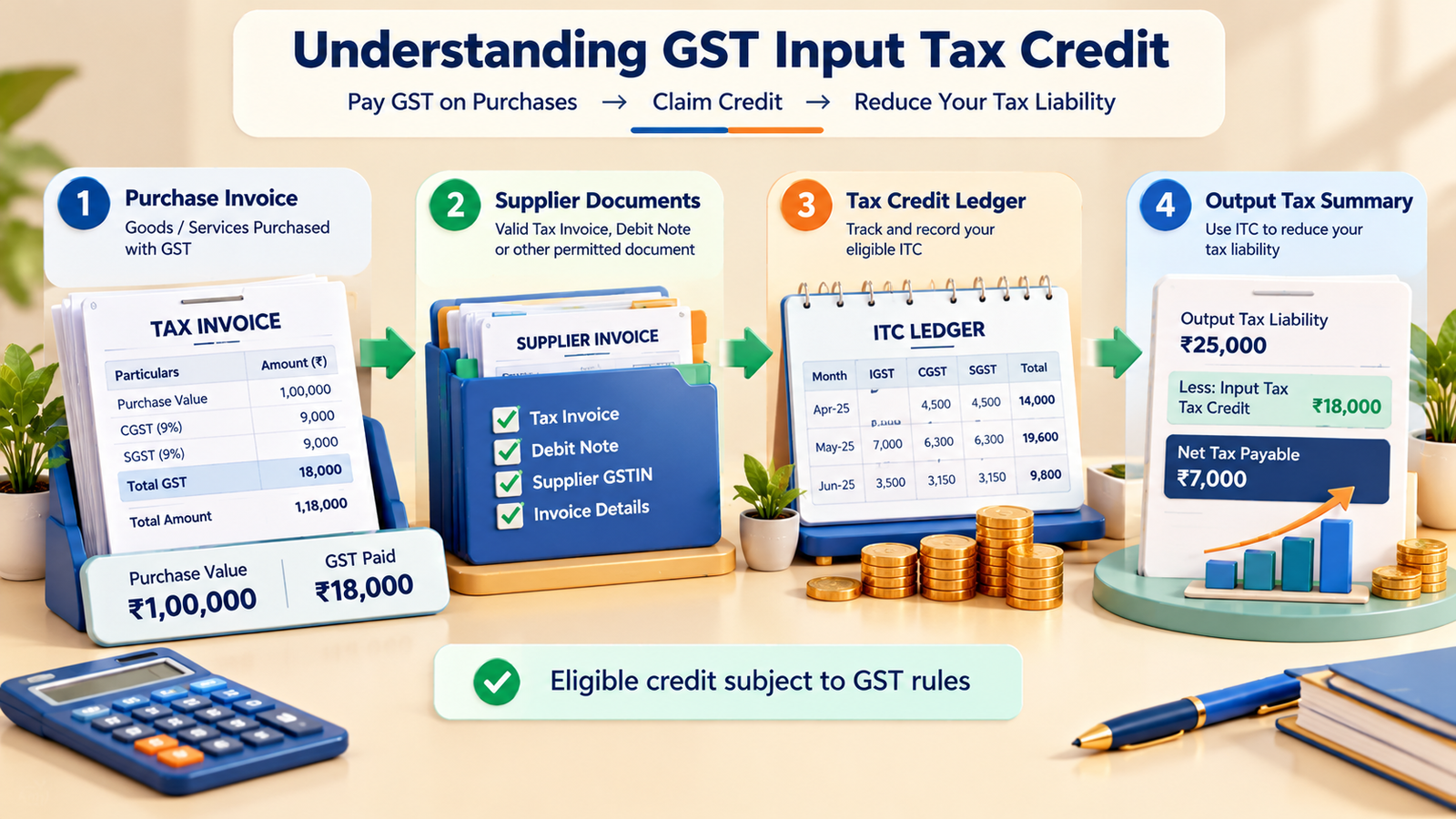
GST input tax credit allows eligible registered taxpayers to reduce their output GST liability by claiming credit for tax paid on eligible business purchases and services, subject to applicable conditions. Correctly managing ITC helps maintain accurate GST records, avoid incorrect claims and identify differences between purchase invoices and supplier-reported information.
Understanding eligibility, invoice requirements and reconciliation procedures is important for businesses that regularly purchase goods or services. A systematic review of purchase records can also help prevent errors when preparing GST returns.
What Is Input Tax Credit Under GST?
Input Tax Credit (ITC) is the credit of eligible GST paid on purchases of goods or services used or intended to be used in the course or furtherance of business. Instead of treating all eligible purchase tax as an unrecoverable cost, a registered taxpayer may claim credit according to the applicable GST provisions.
For example, assume a registered business purchases goods for ₹1,00,000 and pays GST of ₹18,000. If the purchase qualifies for ITC and all applicable requirements are satisfied, the eligible ₹18,000 may be available to offset output tax liability.
This is an illustrative example, not a guarantee that every purchase qualifies. The tax rate, nature of the transaction, supporting documents and statutory restrictions must be checked before claiming credit.
[IMAGE 1 PLACEMENT: Insert after this section]
Image prompt: Create a premium 3D editorial infographic titled “Understanding GST Input Tax Credit.” Show a purchase invoice, GST amount, supplier document folder, a tax credit ledger and an output tax summary connected through clean arrows. Include an illustrative purchase value of ₹1,00,000, GST of ₹18,000 and a clearly marked note “Eligible credit subject to GST rules.” Use a warm cream background, navy-blue headings, muted blue, mint green and subtle orange accents. No people, characters, laptop or logos. Realistic 3D product visualization, soft studio lighting, readable text, landscape 16:9.
Alt text: GST input tax credit illustration showing purchase invoices, GST paid and eligible tax credit records.
Who Can Claim GST Input Tax Credit?
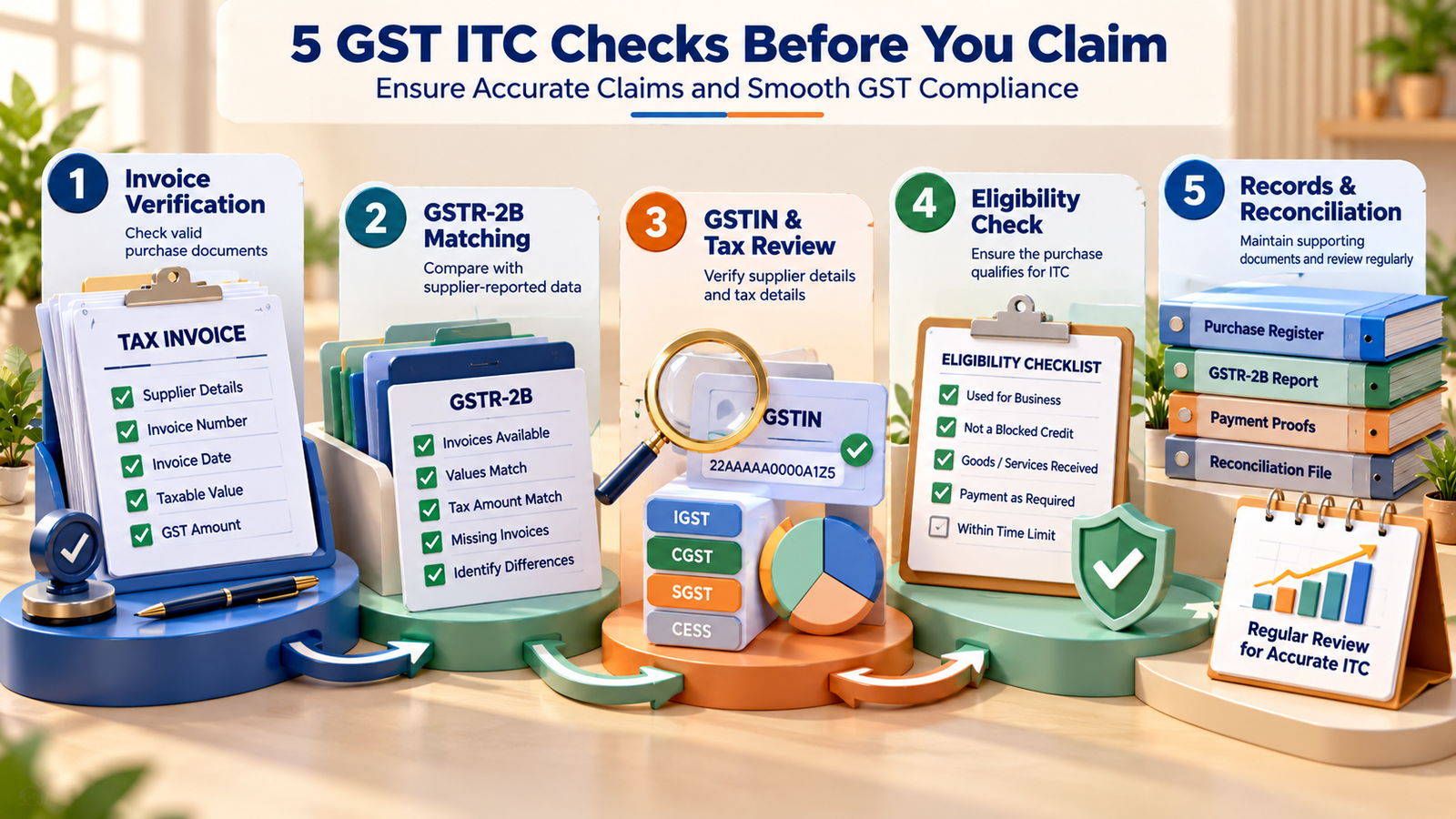
ITC eligibility depends on the taxpayer’s registration status, the nature of the purchase and compliance with the applicable GST law. A registered taxpayer should review the following points before claiming credit.
- The taxpayer must meet the applicable registration and eligibility requirements.
- The purchase should be supported by a valid tax invoice, debit note or another permitted document.
- The goods or services must have been received, subject to the applicable statutory provisions.
- The supplier-reported information and relevant return requirements must be checked.
- The credit must not fall under a restriction or blocked-credit provision.
- Applicable time limits and other statutory conditions must be satisfied.
Certain purchases, including specified personal-use or restricted expenses, may not qualify for credit. The eligibility of each transaction should be assessed according to its actual business purpose and the applicable law.
Why Is GSTR-2B Important for ITC?
GSTR-2B reconciliation is an important step in reviewing purchase-related tax credit. GSTR-2B is an auto-drafted statement that provides information about ITC based on details reported through the GST system. It helps taxpayers identify credit information associated with supplier-reported documents.
However, the appearance of an invoice in GSTR-2B does not automatically mean that credit can be claimed in every case. The taxpayer must also verify eligibility under the relevant provisions, confirm that the transaction is genuine and consider any restrictions that apply.
A practical reconciliation process includes these checks:
- Compare purchase invoices recorded in the accounting system with the documents shown in GSTR-2B.
- Identify invoices that are missing, duplicated or reported with incorrect details.
- Check supplier GSTIN, invoice number, invoice date and taxable value.
- Compare the tax amounts under IGST, CGST, GST and cess, wherever applicable.
- Investigate differences and follow up with suppliers when corrections or clarifications are needed.
- Document the review and retain supporting records.
The official GST system provides guidance on viewing and understanding GSTR-2B. Taxpayers should refer to the official GSTR-2B user guide for portal-specific information and review the latest applicable rules before filing returns.
Common GST Input Tax Credit Mistakes
GST compliance can become difficult when purchase records, supplier data and return information do not match. The following mistakes deserve particular attention.
1. Claiming Credit Without Checking Eligibility
A purchase invoice alone does not establish that every credit is allowable. Taxpayers should check the business purpose, applicable restrictions and other statutory conditions before including a transaction in the ITC calculation.
2. Ignoring Differences in GSTR-2B
An invoice may be absent from the statement, reported with an incorrect value or reflected under unexpected details. Such differences should be investigated rather than automatically adjusted without supporting evidence.
3. Entering Incorrect Invoice Details
Mistakes in invoice numbers, dates, supplier Sting or tax amounts can complicate reconciliation. Consistent data entry and periodic review help reduce these errors.
4. Overlooking Credit Reversals
Certain circumstances may require ITC to be reversed or adjusted under applicable rules. Businesses should review the nature of transactions, payment status where relevant and changes affecting credit eligibility.
5. Failing to Maintain Supporting Documents
Purchase invoices, debit notes, payment records, reconciliation statements and related correspondence should be retained according to applicable record-keeping requirements. Clear documentation makes it easier to explain the treatment of a transaction during a review or assessment.
How to Maintain Accurate ITC Records
GST record maintenance becomes more effective when purchase information is reviewed throughout the tax period instead of waiting until return filing.
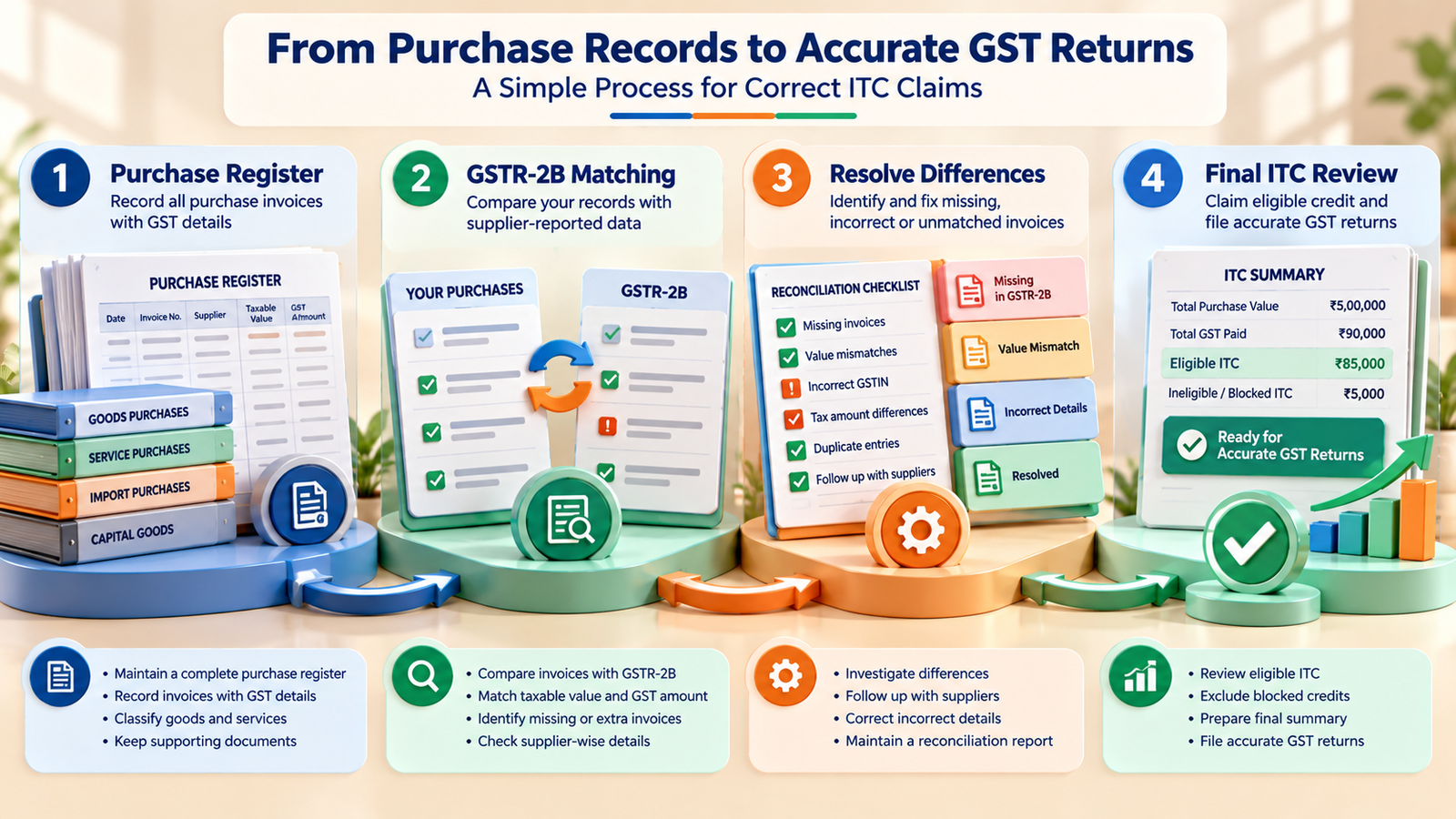
A useful routine is to record purchase invoices promptly, classify transactions correctly and reconcile accounting records against the available GST statements. Maintain a list of unmatched invoices and assign follow-up actions where supplier corrections or additional documents are required.
A monthly review can include:
- Total purchase value and corresponding GST amounts.
- Invoices appearing in accounting records but missing from the available statement.
- Differences between invoice values and supplier-reported figures.
- Potentially restricted or ineligible credits.
- Credit reversals or adjustments that require attention.
- Supporting documents and reconciliation notes.
Businesses using accounting software can improve consistency by following standard purchase-entry procedures and reviewing exceptions regularly. Software reports can help identify differences, but they do not replace a proper eligibility assessment under GST law.
What Should You Do When GSTR-2B and Purchase Records Do Not Match?
GST return reconciliation should start by identifying the exact difference rather than changing figures simply to make the totals agree.
First, confirm that the invoice belongs to the correct tax period and that the purchase has been recorded accurately. Next, check the supplier’s invoice details and relevant documents. If the supplier has not reported the transaction correctly, contact them and request clarification or correction where appropriate.
If an invoice appears in GSTR-2B but the credit may be restricted under the law, assess eligibility separately. Similarly, a purchase recorded in the books but not reflected in the statement should be investigated before any claim is made.
Keep a reconciliation record showing the issue, action taken, supporting evidence and final treatment. The correct treatment depends on the facts and the rules applicable to the relevant tax period.
When Should You Seek Professional GST Assistance?
GST advisory services may be useful when a taxpayer has recurring invoice mismatches, disputed credit eligibility, complex purchase transactions or questions about credit reversals. Professional assistance can also help establish a consistent reconciliation process and identify gaps in supporting records.
Before accepting a credit claim, review the relevant documents and applicable provisions. Where the treatment is uncertain, seek advice from a qualified professional who can assess the specific facts and tax period.
Conclusion
GST input tax credit requires more than entering purchase tax into a return. Taxpayers should confirm eligibility, verify supporting documents, reconcile supplier-reported information and review applicable restrictions before claiming credit.
A consistent process for invoice checking, GSTR-2B reconciliation and record maintenance can reduce avoidable errors and improve the reliability of GST reporting. Since GST rules and procedures may change, always check the current requirements applicable to the relevant tax period before filing.
For help with GST compliance and related records, explore our GST services.
Frequently Asked Questions
1. What is GST input tax credit?
It is credit of eligible GST paid on business purchases of goods or services, subject to the applicable conditions and restrictions.
2. Does every invoice in GSTR-2B qualify for ITC?
No. The taxpayer must independently verify eligibility and comply with the relevant GST provisions.
3. What should I do if an invoice is missing from GSTR-2B?
Check the invoice details and tax period, review supplier-reported information, and follow up with the supplier where appropriate. Assess eligibility before claiming credit.
4. Why should purchase records be reconciled regularly?
Regular reconciliation helps identify missing invoices, incorrect values, supplier reporting differences and potentially ineligible credit before return filing.
5. Can blocked credits be claimed if an invoice is available?
Not necessarily. Credit restrictions under GST law must be considered even when an invoice or transaction appears in the available records.