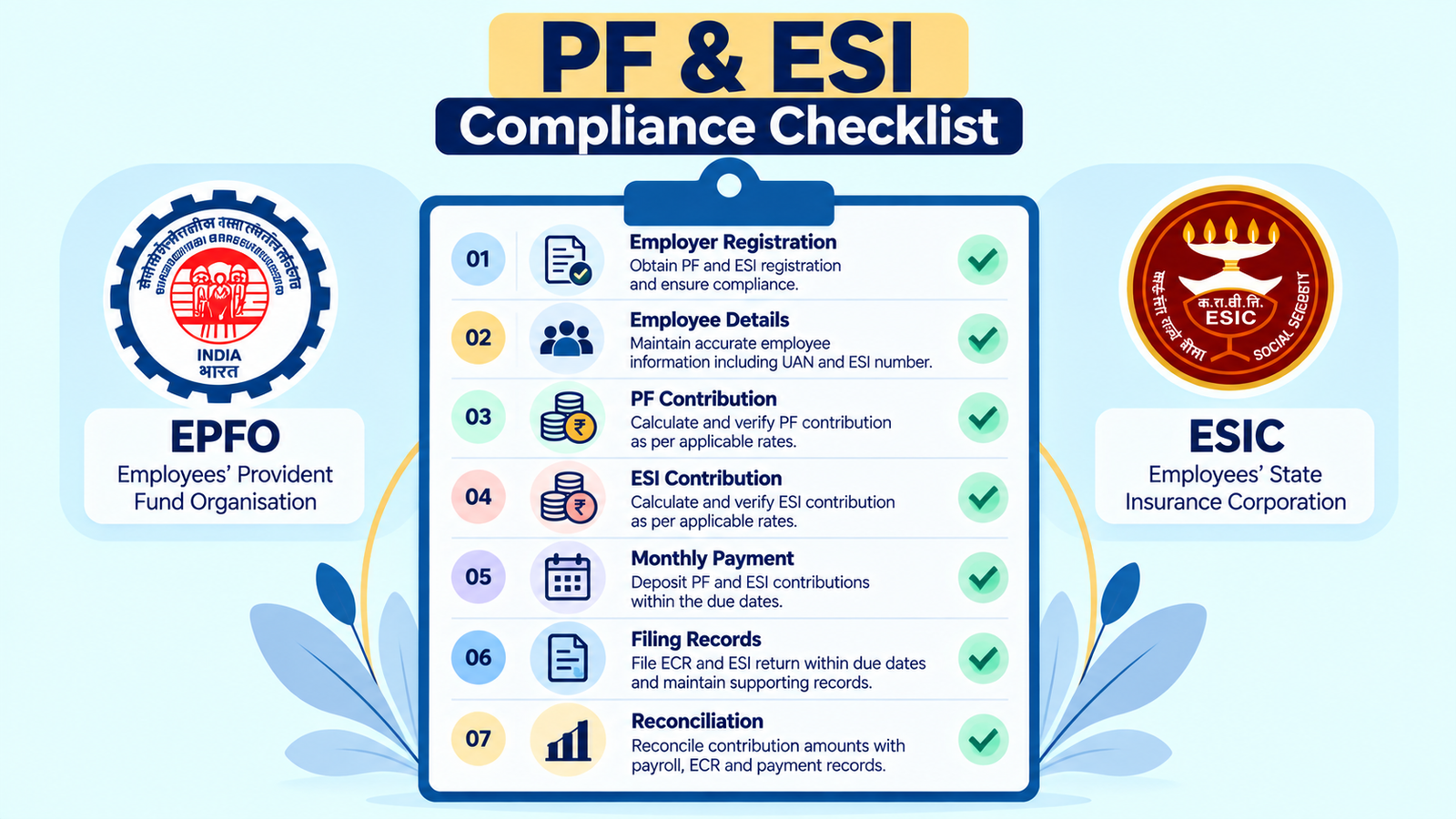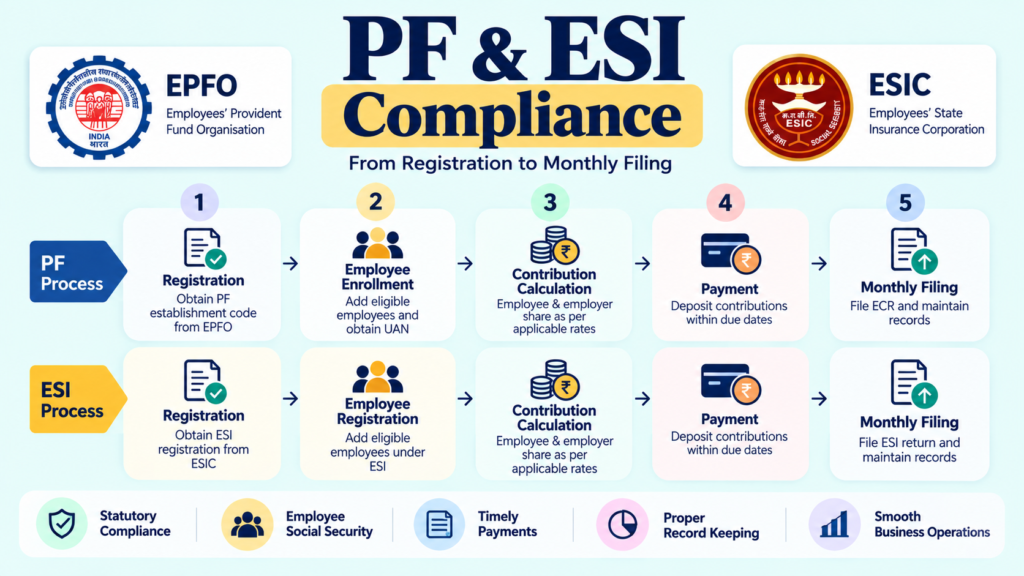
Employee-related statutory compliance is an important responsibility for businesses with employees. Employers may need to manage provident fund requirements, employee insurance coverage, monthly contributions, employee records and related filings depending on the nature and size of the establishment.
Understanding PF ESI compliance helps businesses organise payroll correctly, maintain employee records and make statutory payments within the applicable timelines. This guide explains the basic rules, registration requirements, contribution structure and monthly compliance areas businesses should understand.
What Are PF & ESI Rules?
PF and ESI are two important social-security frameworks for eligible employees in India.
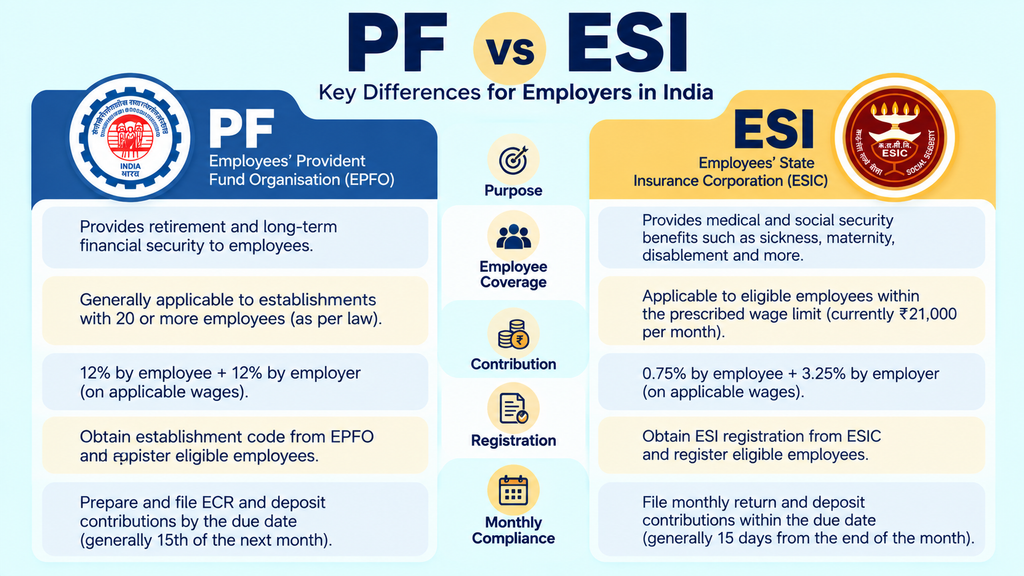
Provident Fund is administered through the Employees’ Provident Fund Organization (EPFO) under the Employees’ Provident Funds and Miscellaneous Provisions Act, 1952. In general, the Act applies to establishments employing 20 or more persons that fall within its coverage, although applicability can depend on the establishment and notifications under the law. The Employees’ State Insurance scheme is administered by ESIC. It provides social-security benefits such as medical, sickness, maternity, disablement and dependants’ benefits to covered employees and their families. Coverage depends on the type of establishment, applicable notifications and employee wage limits.
For an employer, the practical objective is to identify applicability correctly, register where required, calculate contributions accurately and maintain timely records.
What Is Provident Fund?
The Employees’ Provident Fund is a retirement-oriented social-security arrangement for eligible employees. Contributions are made by the employee and employer, subject to the applicable statutory provisions.
For covered employees, the standard contribution structure generally involves a 12% employee contribution and an employer contribution of 12%, with the employer’s share allocated between EPF and pension-related components according to the applicable rules. EPFO states that statutory contributions are generally payable on a wage ceiling of ₹15,000 per month, although contribution on higher wages can be made in specified circumstances.
This means payroll calculations should not be based simply on the employee’s gross salary. Employers need to identify the relevant PF wage components and applicable rules before calculating the monthly amount.
Who Needs PF Registration?
The applicability of PF depends on the establishment, number of employees, nature of the business and the provisions applicable to that establishment.
Businesses approaching or crossing the applicable employee threshold should review their position rather than waiting until a compliance issue arises.
Common situations where businesses may need support include:
- New business setup and employer registration
- Adding new employees to the PF system
- Maintaining employee UAN details
- Updating KYC information
- Monthly contribution calculation
- ECR preparation and submission
- Employee transfer or exit-related updates
- PF-related notices or compliance checks
Businesses looking for professional support can explore our PF services for assistance with registration, payroll-related compliance and employee records.
What Is ESI?
Employees’ State Insurance provides social-security protection to eligible employees against certain contingencies including sickness, maternity, disablement and employment injury.
The current ESI wage ceiling for coverage is ₹21,000 per month, with ₹25,000 applicable for persons with disabilities. However, establishment coverage also depends on the type of establishment and applicable government notifications.
The scheme is funded through contributions from employers and employees.
ESI Contribution and Employee Coverage
The current ESI contribution rate is 4% of wages in total:
- Employer contribution: 3.25%
- Employee contribution: 0.75%
ESIC confirms these rates and also provides that employees whose average daily wages are up to ₹176 are exempt from paying the employee share, while the employer’s contribution remains payable.
Therefore, payroll teams should check employee wages and applicable coverage before calculating deductions.
PF & ESI Registration Process
Registration is an important first step when an establishment becomes covered by the relevant legislation.
For PF, the PF registration process generally involves establishment details, employer information, authorized-person details and other information required through the applicable registration system.
For ESI, the ESI registration process similarly requires establishment and employer information, employee-related details and supporting information as applicable.
The exact documentation and registration workflow can change depending on the establishment and portal requirements. Employers should therefore use the current official portal instructions rather than relying on old forms or screenshots.
For businesses requiring both registrations, completing PF & ESI Registration together can help create a more organised statutory-compliance workflow.
What Is Monthly PF & ESI Compliance?
Monthly PF & ESI compliance involves checking employee payroll data, calculating applicable contributions, making payments and maintaining filing records.
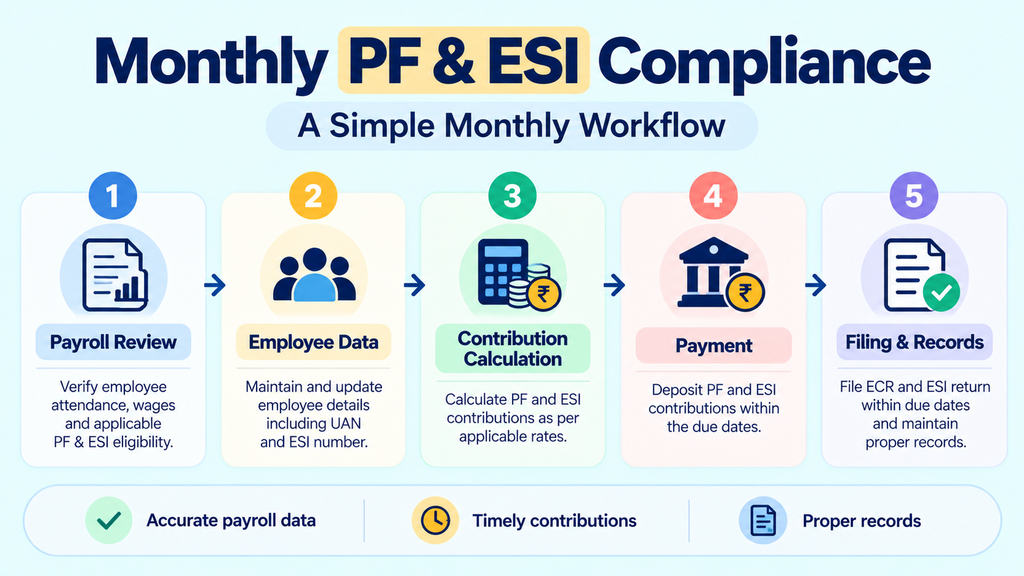
For PF, employers generally prepare monthly contribution information and submit the Electronic Challan-cum-Return (ECR). EPFO’s employer information booklet states that monthly PF contributions should be paid through the employer portal on or before the 15th of every month. For ESI, employers are required to submit monthly contribution information online for employees and deposit the applicable amount within 15 days from the last day of the relevant calendar month.
This makes monthly PF ESI work an important part of payroll administration.
PF and ESI Contribution Rates: Why Payroll Accuracy Matters
Correct calculation is important because employee deductions, employer contributions and statutory records need to agree.
A payroll review should generally check:
- Employee name and identification details
- UAN or insurance-related identification
- Applicable wages
- Employee contribution
- Employer contribution
- New joiners
- Employees who left during the month
- Contribution payment
- Monthly filing records
- Challan and payment confirmation
For PF, the statutory wage ceiling and applicable contribution structure should be checked before finalising payroll. For ESI, the employee’s coverage and wage limit should be reviewed separately.
PF and ESI Employee Records
Maintaining accurate employee records makes monthly compliance much easier.
Important information can include:
- Employee name
- Date of joining
- Date of exit, where applicable
- UAN
- Aadhaar and PAN information where required
- Bank details
- PF contribution records
- ESI insurance details
- Monthly wages
- Employee and employer contribution
- Payment challans
- Filing acknowledgements
Employees may also need UAN services for activities such as checking their PF account, accessing passbook information and managing certain member-related services. The current EPFO member portal provides access to several online member facilities.
PF Return Filing and ESI Return Filing
Monthly statutory work should be completed carefully because errors can affect employee records and employer compliance.
PF return filing involves the applicable monthly contribution data and ECR-related process.
Similarly, ESI return filing and monthly contribution submission require employee-wise wage and contribution information through the ESIC system. ESIC’s current FAQ states that employers file monthly contributions online after registering employees.
Before submitting, employers should reconcile payroll data with the statutory contribution records.
What Happens If Contributions Are Delayed?
Delayed statutory payments can result in additional financial consequences.
For PF, EPFO provides for interest and penal damages in applicable cases involving delayed remittances. EPFO has stated that interest under Section 7Q is 12% per annum, while the notified rate of damages was rationalised to 1% per month for each month of default from 14 June 2024. For ESI, delayed contribution attracts interest under the applicable regulations, and the regulations also provide for damages depending on the period of delay.
Therefore, businesses should avoid treating statutory payments as a year-end activity. Monthly reconciliation is much safer.
Common PF & ESI Compliance Mistakes
Some common problems businesses should watch for include:
Incorrect Employee Details
Errors in names, dates, UAN information or other identification details can create difficulties when employees access their accounts or make claims.
Wrong Wage Calculation
PF and ESI do not necessarily use the same wage calculation approach. Applying one formula to both can lead to incorrect deductions.
Missing New Joiners
New employees should be reviewed during every payroll cycle to determine whether registration or inclusion is required.
Delayed Payments
Missing the applicable payment timeline can result in interest or other consequences.
Poor Record Keeping
Employers should preserve payroll data, contribution calculations, challans, filing acknowledgements and employee records systematically.
Not Reconciling Payroll
The payroll register, statutory contribution amount and payment record should be checked against each other before closing the month.
How Professional PF & ESI Services Can Help
Businesses often have to manage payroll, employee records, statutory payments and compliance deadlines at the same time. A structured compliance process can reduce manual errors and make monthly review easier.
Professional support may include:
- Employer registration assistance
- Employee registration and updates
- Monthly contribution calculation
- ECR and statutory filing support
- ESI contribution processing
- UAN-related assistance
- Employee record maintenance
- Compliance reconciliation
- Notice-related documentation
- Periodic compliance review
You can also review our PF & ESI services to understand the type of statutory support available for businesses.
For employer-side PF matters, businesses can also verify current requirements and portal facilities through the official EPFO Employer Portal.
Frequently Asked Questions
What are PF & ESI rules?
PF and ESI rules cover the applicability, registration, employee coverage, contribution calculation, payment and ongoing compliance requirements under the respective social-security frameworks. The exact requirements depend on the establishment and employee circumstances.
What is the PF wage ceiling?
EPFO currently states a statutory contribution wage ceiling of ₹15,000 per month for PF contributions, subject to applicable provisions and exceptions. Higher-wage contribution arrangements can apply in specified situations.
What is the ESI salary limit?
The current ESI coverage wage limit is ₹21,000 per month, with a ₹25,000 limit for persons with disabilities, subject to the applicable coverage provisions.
When should PF contributions be paid?
EPFO’s employer information booklet states that monthly PF contributions should be paid on or before the 15th of every month.
When should ESI contributions be paid?
ESIC states that contributions are to be paid within 15 days from the last day of the calendar month in which the contribution falls due.
PF & ESI Compliance Checklist
Before closing each payroll month, businesses can review:
- Employer registration status
- New employee additions
- Employee exit details
- UAN and employee records
- Applicable PF wages
- Applicable ESI wages
- Employee contribution
- Employer contribution
- Monthly ECR information
- ESI monthly contribution data
- Challan generation
- Payment confirmation
- Filing acknowledgement
- Payroll-to-statutory reconciliation
- Pending compliance issues or notices
Conclusion
PF and ESI compliance is an ongoing responsibility rather than a one-time registration activity. Businesses need to understand applicability, maintain accurate employee information, calculate contributions correctly and complete monthly statutory payments and filings within the applicable timelines.
A consistent process for payroll reconciliation, statutory payments and record keeping can make compliance easier to manage and can help identify errors before they become larger issues.
Important: PF and ESI applicability can vary based on the establishment, employee category, wage components, location and applicable notifications. Businesses should verify the current rules and portal requirements before taking compliance action.